A look at church wounds and the slow, grace‑filled steps that help survivors reclaim faith, voice, and hope
This post is #2 in a series on Pastoral Anger and Religious Trauma. Find part 1 Here: Understanding Pastoral Anger and Healing.
When the Shepherd’s Voice Hurts the Sheep
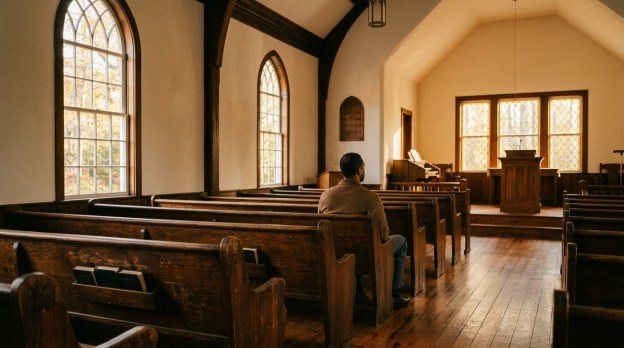
Marcus can still describe the pew. Third row from the back. Left side. By the window. He’d asked his pastor an honest question after Sunday school — the kind of question he figured any pastor would be glad to hear. The next Sunday, he sat in that pew and listened as his question was repeated from the pulpit, mocked, and held up as an example of “the kind of pride that splits churches.”
Nobody said Marcus’s name. They didn’t need to.
He sat still until the closing prayer. He walked to his car. And he didn’t set foot in a church — any church — for nine years.
Some people read a story like Marcus’s and recognize the pew immediately. Others read it and recognize something harder to name — a slow drift, a quiet exit, a faith that used to feel like home and now feels like a building they no longer have keys to. This message is for both.
The Wound and Its Many Shapes
One of the hardest wounds to name is the wound a pastor leaves behind. And it doesn’t leave the same mark on everyone.
Some people walk out of it convinced they were the problem. They flinch at certain Bible verses. They replay conversations. They wonder if they were too sensitive, too forward, too much.
Other people walk out of it furious — and rightly so. They don’t blame themselves. They blame the man. They blame the system that protected him. And somewhere along the way, they stop being able to tell where the man ends and where God begins, so they walk away from the whole thing.
Both responses make sense. Both are honest reactions to a real injury.
Pastoral anger doesn’t always look like yelling. Sometimes it’s a cold rebuke in the church office. Sometimes it’s a sermon that feels aimed at one person — and that person knows exactly who. Sometimes it’s silence when you needed help. Sometimes it’s contempt when you raised a concern. Sometimes it’s a Bible verse pulled off the shelf and swung like a hammer.
The form changes. The damage is real either way.
Why It Cuts So Deep
When a coworker snaps at you, it stings. When a pastor snaps at you, it can rearrange your inner world. There’s a reason for that — and naming it is part of taking your power back.
A pastor speaks with borrowed authority. He opens the Bible. He pronounces the blessing. He prays over your kids. Week after week, his voice gets braided together with God’s voice in the listener’s mind. So when that voice turns sharp, a piece of the spiritual world turns sharp with it. When that voice turns cold, something cosmic feels colder.
That’s not weakness on the part of the listener. That’s the design of the role — and it’s exactly why the role carries weight, and exactly why misuse of it does so much harm. The injury isn’t proof you were naive for trusting. It’s proof somebody mishandled something sacred.
What Anger Is Doing
If you’ve been carrying anger about what happened — at the pastor, at the church, at the people who closed ranks, at God for not stopping any of it — that anger is not a spiritual problem to be talked out of.
Anger is often the first part of a person that wakes up after this kind of wound. It’s the part that says, That was wrong. I didn’t deserve that. Something has to be different now. It’s a signal of self-respect. The Psalms are full of it. Jesus expressed it — in a temple, with a whip, at religious leaders who used their authority to crush people.
You’re allowed to be angry. You’re allowed to be angry for as long as you need to be. What matters in the long run is not how fast you get rid of it — it’s what you do with it so it stops burning you from the inside.
Anger held in silence tends to turn inward, and that’s where it does the most damage to the person carrying it. The work isn’t to suppress it or hurry it along. The work is to give it somewhere to go — onto a page, into a counselor’s office, into honest conversation with a friend who can hold it, into honest prayer if and when that becomes possible again. Anger that gets witnessed loosens its grip. Anger that gets buried keeps burning.
The Help That Didn’t Help
Most people wounded by a pastor’s anger get wounded a second time by what happens next.
Someone tells you, “Don’t touch the Lord’s anointed.” Someone tells you to forgive — fast — before you’ve even finished bleeding. Someone hints that you’re bitter. Or rebellious. Or proud. Friends from church get quiet. Invitations dry up. The community you loved starts feeling like a room you’re no longer welcome in.
That isn’t accountability. That’s protection of the institution at the expense of the person it harmed.
Forgiveness is real, and forgiveness is good. But forgiveness is something a survivor offers from a place of strength — not something extracted from a person who hasn’t even been allowed to say what happened. Anyone telling you to skip the truth-telling and get straight to the forgiving is asking you to bury the wound, not heal it.
The God Behind the Bad Sermon
Here’s something worth saying, slowly: the pastor who hurt you was not a reliable picture of God.
The reliable picture is Jesus. And the Jesus on the pages of the Gospels is not the angry pastor in a bigger robe. Isaiah saw Him coming and described Him this way: “A bruised reed He will not break, and a smoldering wick He will not snuff out” (Isaiah 42:3). If your faith feels like a bruised reed right now — bent, splintered, barely holding shape — He is not the one who will finish breaking it. If your faith feels like a smoldering wick — almost out, more smoke than flame — He is not the one who will blow it out.
Jesus described His own in Matthew 11:29. He said, “I am gentle and lowly in heart.” Not harsh. Not impatient with the limping. Not contemptuous of the slow. Gentle. Lowly. The kind of presence that draws near to the worn-out rather than scolding them for being tired.
This is the Jesus who wept at the grave of His friend. This is the Jesus who, when religious leaders turned the Bible into a weapon, knelt down, drew in the dust, and watched the stones drop out of their hands. This is the Jesus who reserved His sharpest words not for the doubting or the wounded, but for the religious authorities who loaded burdens onto people they wouldn’t lift a finger to help carry.
The voice that hurt you was not the voice of that Jesus. Not the voice of the Good Shepherd. No matter what name tag it was wearing.
You don’t have to manufacture a new God to recover. You may just need to meet the real One — the one who was there underneath all the noise the whole time.
A Path Forward — At Your Pace
Healing from this kind of wound rarely shows up in one dramatic moment. It shows up in small steps. Quiet steps. Unimpressive-looking steps that God uses anyway. Here are seven worth considering:
- Name what happened. Out loud, on paper, to a counselor, to a trusted friend. You cannot heal a wound you’re not allowed to describe. Naming it is not bitterness. Naming it is the first act of honesty.
- Let the anger have somewhere to go. Write it. Speak it. Bring it to someone who can hold it without flinching. Anger witnessed loses its heat. Anger buried keeps burning.
- Find a counselor who gets it. Look for someone trained in religious trauma — a person who won’t pathologize your doubt and won’t pressure you toward a particular spiritual outcome. Their job is to help you think clearly.
- Find your fellow travelers. Shame loses its grip in good company. There are more people walking this road than you realize. You are not the only one. You are not even close to the only one.
- Reclaim what was always yours. The pastor who hurt you did not invent faith. He didn’t invent prayer, Scripture, worship, or community. Those things existed before him and will exist after him. Decide, on your own timeline, which of them you want back.
- Meet Jesus again, slowly. Read the Gospels straight through, in a translation that doesn’t sound like the voice that wounded you. Watch how He treats the tired, the doubting, the outsiders, the ones the religious system had written off. Let that picture do its work.
- Give yourself permission to take as long as this takes. There is no spiritual deadline on recovery. God is not tapping His foot. The Good Shepherd does not count sheep by how fast they walk.
A Word for Wherever You Are
Maybe you’re reading this in a church parking lot you can’t bring yourself to enter. Maybe at a kitchen table a hundred miles from any sanctuary. Maybe in a life you’ve quietly rebuilt without any of it, and you’re not sure why you clicked on this at all.
What was done to you was real. What you do next is yours.
But here’s something worth sitting with: the Shepherd who actually exists — the one Isaiah described and Jesus revealed — is gentle and lowly in heart. He will not break the bruised reed. He will not snuff out the smoldering wick. He is not the voice that wounded you, and He never was.
“The Lord is my shepherd” was written by a man who knew exactly what bad shepherds looked like. David wasn’t naive when he wrote those words. He had seen the worst of human leadership up close. And still, somewhere along the way, he met a different kind of Shepherd — and he spent the rest of his life trying to put that meeting into words.
So here’s the question worth carrying with you, gently, on your own timeline:
If the voice that hurt you was not the voice of the Good Shepherd — what might it be like to listen, just once, for the One who actually is?
 Chuck Anderson