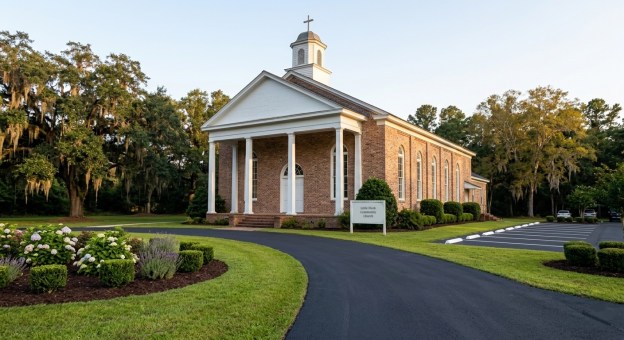
Every church tells a story long before anyone reads its history. You can feel it in the hallways, hear it in the prayers, and see it in the way people treat one another. Some churches carry the unmistakable aroma of life—hope, joy, repentance, mission, and a kind of holy expectancy that can’t be manufactured. Others feel tired, cautious, and quietly resigned. They may still gather, still sing, still maintain the calendar, but the pulse is faint.
Scripture gives us categories for both. Jesus speaks of branches that bear fruit and branches that wither (John 15). He warns churches that lose their first love (Revelation 2) and celebrates churches that remain faithful under pressure (Revelation 3). The early church in Acts is marked by devotion, generosity, and multiplication, while other congregations in the New Testament drift into division, legalism, or spiritual apathy.
The difference between a living church and a dying one is rarely about size, budget, or architecture. It is almost always about spiritual posture—what the people love, what they trust, what they pursue, and what they refuse to ignore.
What follows is a simple diagnostic. Eight contrasts. Eight places where Scripture shines a light on the difference between a church that is reproducing life and a church that is quietly slipping into decline.
1. A Living Church Treasures the Gospel; a Dying Church Assumes It Paul tells the Corinthians that the gospel is of “first importance” (1 Corinthians 15:3). Living churches never graduate from that. They preach Christ crucified with clarity and joy. They keep grace at the center of every ministry.
Dying churches still use gospel language, but the message becomes assumed rather than proclaimed. The sermons drift toward moral improvement. The songs become vague. The prayers lose their urgency. When the gospel becomes background noise, decline is already underway.
2. A Living Church Depends on the Spirit; a Dying Church Depends on Memory Jesus’ words are blunt: “Apart from Me you can do nothing” (John 15:5). Living churches believe Him. They pray like people who know they are powerless without God. They expect the Spirit to convict, comfort, and convert.
Dying churches rely on what used to work. They cling to familiar patterns not because they’re fruitful but because they’re predictable. Their functional trust is in yesterday’s methods rather than today’s Spirit. The result is a slow, quiet suffocation of spiritual vitality.
3. A Living Church Obeys the Great Commission; a Dying Church Protects Its Comfort Jesus’ final command was to “make disciples of all nations” (Matthew 28:19). Living churches measure success by disciple-making, not by attendance or activity. They ask, “Who are we reaching? Who are we teaching? Who are we sending?”
Dying churches shift from mission to maintenance. The primary question becomes, “How do we keep things going?” The calendar stays full, but the baptistry stays dry. Comfort becomes the hidden idol, and mission becomes the forgotten mandate.
4. A Living Church Welcomes the Next Generation; a Dying Church Resents Their Disruption Psalm 145:4 says, “One generation shall commend Your works to another.” Living churches take that seriously. They invest in children and students. They gladly endure noise, mess, and change because they know the gospel must be handed forward.
Dying churches see the next generation as a threat to the way things have always been. They resist new voices, new ideas, and new leaders. The young quietly slip away, and the church ages into irrelevance.
5. A Living Church Practices Repentance; a Dying Church Practices Blame When Peter preached at Pentecost, the people were “cut to the heart” and asked, “What shall we do?” (Acts 2:37). Living churches stay soft before God. They confess sin. They repent quickly. They welcome correction.
Dying churches harden. Problems are always someone else’s fault—culture, politics, the pastor, the music, the neighborhood. Repentance dries up, and with it, the possibility of renewal.
6. A Living Church Celebrates Sacrificial Service; a Dying Church Protects Personal Preference Jesus said, “Whoever would be great among you must be your servant” (Mark 10:43). Living churches overflow with people who serve because they love Christ and His people. They see ministry as privilege, not burden.
Dying churches are filled with people who guard their preferences. They want their ministry, their seat, their style. When preference becomes king, mission becomes impossible. A church that will not serve will not survive.
7. A Living Church Embraces Holy Risk; a Dying Church Clings to Safe Predictability Hebrews 11 is a gallery of people who moved when God spoke. Faith always steps forward. Living churches take risks for the sake of the gospel. They plant new groups, start new ministries, and attempt things that require God’s help.
Dying churches fear change. They prefer the safety of stagnation to the vulnerability of obedience. They forget that faithfulness has always required courage.
8. A Living Church Reproduces; a Dying Church Preserves Jesus describes the kingdom as a seed that grows and multiplies (Mark 4:26–29). Living churches reproduce—new disciples, new leaders, new ministries, sometimes even new congregations. They understand that spiritual life is meant to multiply.
Dying churches focus on preserving what remains. They hold tightly to what they have instead of planting what could be. Preservation feels safe, but it slowly suffocates mission.
CONCLUSION. Every church is moving in one of these two directions. No congregation stays neutral. The good news is that Jesus delights to breathe life into dry bones. He restores first love. He rekindles mission. He softens hearts. He awakens prayer. He revives what looks beyond repair.
A living, reproducing church is not a result of human strategy. It is the fruit of a people who return again and again to the gospel, depend on the Spirit, obey the mission, welcome the next generation, repent freely, serve joyfully, risk faithfully, and plant generously.
Wherever a church humbles itself before Christ and follows Him with open hands, life begins to grow again. And when life grows, it multiplies. That is the story Jesus loves to write
 Chuck Anderson